Tuesday, December 27, 2011

Building Design and Construction Handbook, 6th Edition by Frederick S. Merritt, Jonathan T. Ricketts

Building Design and Construction Handbook, 6th Edition by Frederick S. Merritt, Jonathan T. Ricketts

Building Design and Construction Handbook, 6th Edition by Frederick S. Merritt, Jonathan T. Ricketts Overview

A where-would-you-be-without-it handbook covering every single important step in building design and construction, now updated to include key changes in design and construction practices. Surveys materials, structures, soil mechanics and foundations, building types, hardware, insulation, acoustics, plumbing, and more--all the material that will help architects, engineers, contractors, and others work better, faster, and smarter. Includes new design specifications; the latest developments in seismic and wind design criteria; new building systems and material; updated building codes throughout; NFPA requirements; and new wood material and codes.

Frederick S. Merritt (deceased) was a consulting engineer for many years, with experience in building and bridge design, structural analysis, and construction management. A Fellow of the American Society of Civil Engineers and a Senior Member of ASTM, he was a former senior editor of Engineering News-Record and an author/editor of many books, including McGraw-Hill’s Standard Handbook for Civil Engineers and Structural Steel Designer’s Handbook. Jonathan T. Ricketts is a consulting engineer with broad experience in general environmental design and construction management. A registered engineer in several states, he is an active member of the American Society of Civil Engineers, the National Society of Professional Engineers, and the Solid Waste Association of North America.

Monday, December 26, 2011

Building Construction Illustrated by Frank Ching

Building Construction Illustrated by Frank Ching

Building Construction Illustrated by Frank Ching Overview

The classic visual guide to the basics of building construction, now with the most current information
For nearly three decades, Building Construction Illustrated has offered an outstanding introduction to the principles of building construction. This new edition of the revered classic remains as relevant as ever—providing the latest information in Francis D.K. Ching's signature style. Its rich and comprehensive approach clearly presents all of the basic concepts underlying building construction and equips readers with useful guidelines for approaching virtually any new materials or techniques they may encounter.
Laying out the material and structural choices available, it provides a full under–standing of how these choices affect a building's form and dimensions. Complete with more than 1,000 illustrations, the book moves through each of the key stages of the design process, from site selection to building components, mechanical systems, and finishes.
  • Illustrated throughout with clear and accurate drawings that present the state of the art in construction processes and materials
  • Updated and revised to include the latest knowledge on sustainability, incorporation of building systems, and use of new materials
  • Archetypal drawings offer clear inspiration for designers and drafters
  • Reflects the most current building codes and CSI Master Format numbering scheme
With its comprehensive and lucid presentation of everything from foundations and floor systems to finish work, Building Construction Illustrated, Fourth Edition equips students and professionals in all areas of architecture and construction with useful guidelines for approaching virtually any new materials or techniques they may encounter in building planning, design, and construction.

Sunday, December 25, 2011

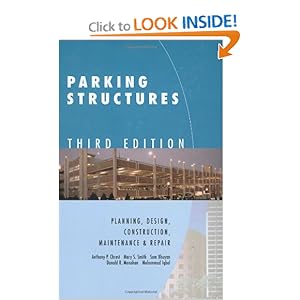
Parking Structures: Planning, Design, Construction, Maintenance and Repair by Anthony P. Chrest, Mary S. Smith, Sam Bhuyan, Mohammad Iqbal

Parking Structures: Planning, Design, Construction, Maintenance and Repair by Anthony P. Chrest, Mary S. Smith, Sam Bhuyan, Mohammad Iqbal

Parking Structures: Planning, Design, Construction, Maintenance and Repair by Anthony P. Chrest, Mary S. Smith, Sam Bhuyan, Mohammad Iqbal Overview

Parking Structures provides a single-source reference for parking structure designers, builders, and owners. This third edition is still the only such book. It addresses how to select the best functional and structural designs for a given situation, ensure long-term durability, design for easy maintenance, decide on the number and placement of entrances and exits, design an easily understood wayfinding system, design for ADA compliance, plan for internal auto and pedestrian traffic circulation, select the most effective and energy efficient lighting system, avoid the most common design and construction pitfalls, provide for adequate patron safety and security, carry out needed repairs, and extend the parking structure life. Parking Structures addresses all the major issues related to parking garages. It is an essential reference for parking structure owners, structural engineers, architects, contractors, and other professionals. New in the third edition: This third edition of Parking Structures includes new material on metric dimensions and recommendations for functional design globally, new research on flow capacity and queuing at parking entry/exits, an entirely new chapter on planning for a new parking structure, including cost issues and alternatives to structure construction, pedestrian considerations, safety in parking facilities, plazas above parking structures, an expanded chapter on seismic design, seismic retrofit, life cycle cost analysis, and upgrades to existing structures.

Saturday, December 24, 2011

Seismic Design of Buildings to Eurocode 8 by Ahmed Elghazouli

Seismic Design of Buildings to Eurocode 8 by Ahmed Elghazouli

Seismic Design of Buildings to Eurocode 8 by Ahmed Elghazouli Overview

Practical information and training has become urgently needed for the new Eurocode 8 on the Design of Structures for Earthquake Resistance, especially in relation to the underlying principles of seismic behaviour and the design of building structures.

This book covers seismic design in a clear but brief manner and links the principles to the code, illustrated with design examples. Concrete and steel buildings, and their foundations, are given special emphasis but the book is widely applicable.

It stems from practical short courses on seismic design, run jointly by the Society for Earthquake and Civil Engineering Dynamics and Imperial College London. Written by senior academics with significant consulting experience and by leading practitioners, it has a strong industry emphasis. It suits a wide range of practising civil and structural engineers, academics preparing courses and needing worked examples, and advanced undergraduate and Masters students in Earthquake,

Friday, December 23, 2011

Steel Structures Design: ASD/LRFD by Alan Williams

Steel Structures Design: ASD/LRFD by Alan Williams

Steel Structures Design: ASD/LRFD by Alan Williams Overview

A COMPLETE GUIDE TO THE DESIGN OF STEEL STRUCTURES

Steel Structures Design: ASD/LRFD introduces the theoretical background and fundamental basis of steel design and covers the detailed design of members and their connections. This in-depth resource provides clear interpretations of the American Institute of Steel Construction (AISC) Specification for Structural Steel Buildings, 2010 edition, the American Society of Civil Engineers (ASCE) Minimum Design Loads for Buildings and Other Structures, 2010 edition, and the International Code Council (ICC) International Building Code, 2012 edition. The code requirements are illustrated with 170 design examples, including concise, step-by-step solutions.
Coverage includes:
  • Steel buildings and design criteria
  • Design loads
  • Behavior of steel structures under design loads
  • Design of steel structures under design loads
  • Design of steel beams in flexure
  • Design of steel beams for shear and torsion
  • Design of compression members
  • Stability of frames
  • Design by inelastic analysis
  • Design of tension members
  • Design of bolted and welded connections
  • Plate girders
Alan Williams, Ph.D., S.E., F.I.C.E., C. Eng., is Senior Transportation Engineer in the California Department of Transportation. A registered structural engineer, he served as a Division of State Architect in California, in which capacity he was Principal for structural safety, and was involved in the design and construction of bridges, schools, and commercial and industrial structures. Dr. Williams is a member of the Structural Engineers Association of Southern California and Fellow and Life Member of the Institution of Civil Engineers, UK.

Thursday, December 22, 2011

The Seismic Design Handbook by Farzad Naeim

The Seismic Design Handbook by Farzad Naeim

The Seismic Design Handbook by Farzad Naeim Overview

The Seismic Design Handbook is a primary resource for both researchers and teachers in the field of earthquake-resistant design. The first edition of this handbook was received with much enthusiasm. It is the de-facto textbook for teaching seismic design principles at many major universities. In the United States, UC Berkeley, Stanford, UCLA, University of Southern California, SUNY Buffalo, the University of Illinois, Washington University, the University of Texas at Austin, Georgia Tech, Cornell, and the University of Michigan have adopted the text. Abroad, the Imperial College of London and the Israel Institute of Technology are among its adopters. This second edition contains up-to-date information on planning, analysis, and design of earthquake-resistant building structures. Its intention is to provide engineers, architects, developers, and students of structural engineering and architecture with authoritative, yet practical, design information. It bridges the gap between advances in the theories and concepts of seismic design and their implementation in practice. This handbook has been endorsed by the International Conference of Building Officials. Audience: The Seismic Design Handbook is a must for practicing engineers, architects, building officials, developers, teachers, and students in the field of earthquake-resistant building design. Its distinguished panel of contributors is made up of 22 experts from industry and universities, recognized for their knowledge and extensive practical experience in their fields.

Wednesday, December 21, 2011

Principles and Practice of Land Surveying Sample Examination by George M. Cole

Principles and Practice of Land Surveying Sample Examination by George M. Cole

Principles and Practice of Land Surveying Sample Examination by George M. Cole Overview

Principles and Practice of Land Surveying Sample Examination by George M. Cole

Tuesday, December 20, 2011

Landslides: Risk Analysis and Sustainable Disaster Management by Kyoji Sassa, Hiroshi. Fukuoka, Fawu Wang, Gonghui Wang

Landslides: Risk Analysis and Sustainable Disaster Management by Kyoji Sassa, Hiroshi. Fukuoka, Fawu Wang, Gonghui Wang

Landslides: Risk Analysis and Sustainable Disaster Management by Kyoji Sassa, Hiroshi. Fukuoka, Fawu Wang, Gonghui Wang Overview

Based on contributions to the first General Assembly of the International Consortium on Landslides,  this reference and status report emphasizes the mechanisms of different types of landslides, landslide risk analysis, and sustainable disaster management. It comprises the achievements of the ICL over the past three years, since the Kyoto assembly. It consists of three parts: research results of the International Programme on Landslides (IPL); contributions on landslide risk analysis; and articles on sustainable disaster management. In addition, the history of the ICL activities (under the support of UNESCO, WMO, FAO, UN/ISDR, and UNU) is recounted to create a comprehensive overview of  international activity on landslides. The contributions reflect a wide range of topics and concerns, randing from field studies, identification of objects of cultural heritage at landslide risk, as well as landslide countermeasures.

Monday, December 19, 2011

Geotechnical Earthquake Engineering: Simplified Analyses with Case Studies and Examples by Milutin Srbulov

Geotechnical Earthquake Engineering: Simplified Analyses with Case Studies and Examples by Milutin Srbulov

Geotechnical Earthquake Engineering: Simplified Analyses with Case Studies and Examples by Milutin Srbulov Overview

Included on the Choice list with the outstanding academic Earth Sciences titles 2008" ... This volume describes simplified dynamic analyses that bridge the gap between the rather limited provisions of design codes and the rather eclectic methods used in sophisticated analyses. Graphs and spreadsheets are included for the ease and speed of use of simplified analyses of: soil slope (in)stability and displacements caused by earthquakes,sand liquefaction and flow caused by earthquakes,dynamic soil-foundation interaction,bearing capacity and additional settlement of shallow foundations,earthquake motion effects on tunnels and shafts,frequent liquefaction potential mitigation measures.A number of comments on the assumptions used in different methods, limitation and factors affecting the results are given. Several case histories are also included in the appendices in order to assess the accuracy and usefulness of the simplified methods. Audience This work is of interest to geotechnical engineers, engineering geologists, earthquake engineers and students.

Sunday, December 18, 2011

Engineering Press at OUP: Civil Engineering License Problems and Solutions, 14th edition by Donald G. Newnan

Engineering Press at OUP: Civil Engineering License Problems and Solutions, 14th edition by Donald G. Newnan

Engineering Press at OUP: Civil Engineering License Problems and Solutions, 14th edition by Donald G. Newnan Overview

This book may be used as a separate, stand-alone volume or in conjunction with Civil Engineering License Review, 14/e (ISBN 1-57645-029-5). Its chapter topics match those of the License Review book. All of the problems have been reproduced for each chapter, followed by detailed step-by-step solutions. Similarly, the 24-problem sample exam (12 essay and 12 multiple-choice problems) is given, followed by step-by-step solutions to the exam. Engineers looking for a CE/PE review with problems and solutions will buy both books. Those who want only an elaborate set of exam problems, a sample exam, and detailed solutions to every problem will purchase this book. 100% problems and solutions.

Saturday, December 17, 2011

A Guide to Techniques in Historical Seismology: Earthquakes and Tsunamis in the Past by Emanuela Guidoboni, John E. Ebel

A Guide to Techniques in Historical Seismology: Earthquakes and Tsunamis in the Past by Emanuela Guidoboni, John E. Ebel

A Guide to Techniques in Historical Seismology: Earthquakes and Tsunamis in the Past by Emanuela Guidoboni, John E. Ebel Overview

This handbook defines the discipline of historical seismology by detailing the latest research methodologies for studying historical earthquakes and tsunamis. It describes the various sources that reference seismic phenomena, discusses the critical problems of interpreting such sources, and presents a summary of the theories proposed throughout history to explain the causes of earthquakes. Incorporating examples from a broad geographic region (including Europe, North Africa, the Middle East, central Asia, and the Americas), the text presents numerous interpretations and misinterpretations of historical earthquakes and tsunamis in order to illustrate the key techniques. The authors also tie historical seismology research to archaeological investigations, and demonstrate how new scientific databases and catalogues can be compiled from information derived from the methodologies described. This is an important new reference for scientists, engineers, historians and archaeologists, providing a valuable foundation for understanding the Earth's seismic past and potential future seismic hazard.

This important reference book for scientists, engineers, historians and archaeologists, defines the discipline of historical seismology by detailing the latest research methodologies for studying historical earthquakes and tsunamis. Incorporating examples from a broad geographic region to illustrate key techniques, it provides an important basis for understanding future seismic hazards.

Friday, December 16, 2011

Design of Highway Bridges: Based on AASHTO LRFD, Bridge Design Specifications by Richard M. Barker, Jay A. Puckett

Design of Highway Bridges: Based on AASHTO LRFD, Bridge Design Specifications by Richard M. Barker, Jay A. Puckett

Design of Highway Bridges: Based on AASHTO LRFD, Bridge Design Specifications by Richard M. Barker, Jay A. Puckett Overview

An up-to-date introduction to the theory and principles of highway bridge design

Design of Highway Bridges offers detailed coverage of engineering basics for the design of short- and medium-span bridges. Based on the new American Association of State Highway and Transportation Officials (AASHTO) LRFD Bridge Design Specifications, this comprehensive text is an excellent engineering resource. The book contains:
* A historical overview of bridge engineering
* Information on key bridge types, selection principles, and aesthetic issues
* An in-depth examination of design considerations-including limit states, load and resistance factors, and substructure design
* Separate chapters on concrete, steel, and timber structures
* System analysis procedures for gravity and lateral loads, plus influence functions and girder-line analysis
* Sample problems covering different bridge systems
* Selected references for further study, and more

Bridges are the lynchpin of the transportation network. They are expensive to build, and how well their design handles the parameters of strength, durability, capacity, and safety can determine the viability of the entire system.

Design of Highway Bridges provides a complete introduction to this important area of engineering, with comprehensive coverage of the theory, specifications, and procedures for the design of short- and medium-span bridges. Beginning with an overview of bridge engineering history, the book examines key bridge types, selection principles, and aesthetic considerations. Design issues are then discussed in detail, from limit states and loads to resistance factors and substructure design.

Up-to-date with the latest American Association of State Highway and Transportation Officials (AASHTO) LRFD Bridge Design Specifications and current system analysis techniques, the text features discrete coverage of concrete, steel, and timber structures. Selected sample problems and references are included to reinforce the concepts presented and give the material a real-world edge.

Whether you are aiming to gain quick familiarity with the new AASHTO guidelines or are seeking broader guidance on highway bridge design, this ready reference puts the information you need right at your fingertips.

Thursday, December 15, 2011

Civil Engineering Problem Solving Flowcharts, 2nd Edition by Jorge L. Rodriguez

Civil Engineering Problem Solving Flowcharts, 2nd Edition by Jorge L. Rodriguez

Civil Engineering Problem Solving Flowcharts, 2nd Edition by Jorge L. Rodriguez Overview

Here are 89 flowcharts to help you solve typical problems found on the Civil Engineering/Professional Engineering Examination. The flowcharts combine theory and formulas to show the logical steps in the solution of the problem. Flowcharts are provided for problems in areas such as Fluid Statics and Dynamics; Hydraulic Machines; Open Channel Flow; Hydrology; Water Supply and Waste Water Engineering; Solid Waste; Soils; Foundations and Retaining Walls; Mechanics of Materials; Steel and Reinforced Concrete Design; Traffic and Transportation; Surveying; and Earthquake Design. Each flowchart is accompanied by an example problem to illustrate the flowchart's step-by-step solution procedure.

Wednesday, December 14, 2011

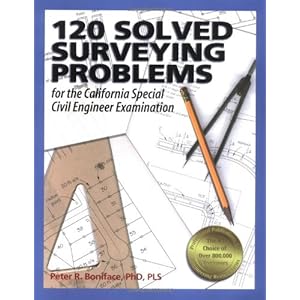
120 Solved Surveying Problems for the California Special Civil Engineer Examination (Engineering Review) by Peter R. Boniface

120 Solved Surveying Problems for the California Special Civil Engineer Examination (Engineering Review) by Peter R. Boniface

120 Solved Surveying Problems for the California Special Civil Engineer Examination (Engineering Review) by Peter R. Boniface Overview

Solving these 120 exam-like surveying problems will help you gain confidence to take and pass the surveying portion of the California Special Civil Engineer exam. Complete solutions allow you to check your solving methods so you'll understand how to efficiently reach the correct answers. Information is provided about the exam format and how to best use this book for successful exam preparation.

Tuesday, December 13, 2011

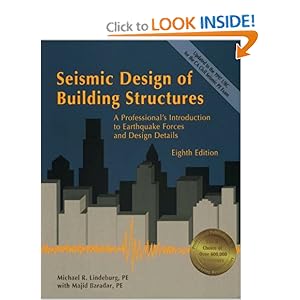
A Professional's Introduction to Earthquake Forces and Design Details: Seismic Design of Building Structures by Michael R. Lindeburg, Majid Baradar

A Professional's Introduction to Earthquake Forces and Design Details: Seismic Design of Building Structures by Michael R. Lindeburg, Majid Baradar

A Professional's Introduction to Earthquake Forces and Design Details: Seismic Design of Building Structures by Michael R. Lindeburg, Majid Baradar Overview

Seismic Design of Building Structures provides essential background instruction for the seismic problems on the civil PE exam. Using relevant codes, this book presents topics from basic seismic concepts through detailing requirements. The 30 sample problems and 113 practice problems, all with step-by-step solutions, offer valuable preparation for the exam. The eighth edition references the 1997 Uniform Building Code, the version of the code currently tested on the exam.
Exam subjects covered include:
Analysis of diaphragms
Detailing of roof-wall connections
Calculating chord and strut forces
UBC nailing requirements
Bolt strengths


Michael R. Lindeburg, PE, is recognized among the engineering community as the leading authority on professional engineering licensing exam preparation. The author of many books on this subject, he has taught and supervised exam-review courses for over 25 years. He holds BS and MS degrees from Stanford University in industrial engineering.

2011 CA California Special Civil Engineer Exam Sesimic Design Simulation Software, 1,000 Questions for both Seismic Principles and Engineering Surveying by Ron Angotti, Sharmistha Shih, Jeffrey Bechham, Alejandra Sims

2011 CA California Special Civil Engineer Exam Sesimic Design Simulation Software, 1,000 Questions for both Seismic Principles and Engineering Surveying

2011 CA California Special Civil Engineer Exam Sesimic Design Simulation Software, 1,000 Questions for both Seismic Principles and Engineering Surveying Overview

1,000 Total Questions for both Seismic Principles and Engineering Surveying portions of the Exam. The most sample questions in one resource! You have the Edge! You now have an "insiders view" of the Exam in every detail, in the exact Environment and patterns as test day! 50 multiple choice questions per exam will be simulated. "Two Timers®" with on/off functions! You have a choice of "per question" timer to track your time usage per question and a "per exam" timer which displays time left for the entire exam. Answer Display Functions. Display the answers after each question or all answers at the end of the exam. The rationale of the correct answer is explained to help you understand why the answer is correct. Mark for Review Feature. Results Review. Print. Not Online only. This is installable software. Seismic Data and Design Criteria (27% of total problems) Seismic Characteristics of Engineered Systems (24%) Seismic Forces (20%) Seismic Analysis Procedures (18%) Seismic Design (11%) Field Measurements (11%) Calculations (33%) Surveying Office Procedures (41%)

345 Solved Seismic Design Problems by Majid Baradar

345 Solved Seismic Design Problems by Majid Baradar

345 Solved Seismic Design Problems by Majid Baradar Overview

Helps prepare for the civil PE exam. Covers Seismology principles, earthquake characteristics, Codes and regularity provisions, Diaphragm theory, Details of structures and Design problems. Paper. DLC: Earthquake resistant designs - Problems, exercises, etc.

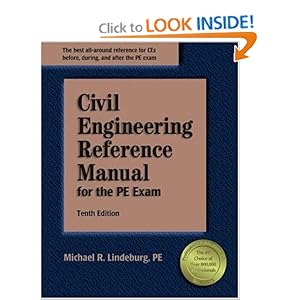
Civil Engineering Reference Manual for the PE Exam, 10th Edition by Michael R. Lindeburg

Civil Engineering Reference Manual for the PE Exam, 10th Edition by Michael R. Lindeburg

Civil Engineering Reference Manual for the PE Exam, 10th Edition by Michael R. Lindeburg Overview

The Most Trusted Reference for the Civil PE Exam…is Also the Most Up-To-Date
As the most comprehensive reference and study guide available for engineers preparing for the breadth-and-depth civil PE examination, the tenth edition of the Civil Engineering Reference Manual provides a concentrated review of the exam topics. No other exam-focused publication is more complete. CERM10 provides the topical review and the support material you need to pass the civil PE exam.

New for the 10th Edition New structural design standards Updates to over 14 chapters 12 new concrete column interaction diagrams Revised tables of data and fundamental constants 100 new index entries

Organized by Subject Areas Covered on the Exam Environmental Geotechnical Structural Transportation Water Resources

Civil Engineering Reference Manual for the PE Exam by Michael R. Lindeburg

Civil Engineering Reference Manual for the PE Exam by Michael R. Lindeburg

Civil Engineering Reference Manual for the PE Exam by Michael R. Lindeburg Overview

The Civil Engineering Reference Manual is the most accurate and comprehensive reference for the Civil PE exam. This trusted text covers all the topics, codes, and standards on the NCEES Civil PE exam specifications. Clear and focused explanations of civil engineering concepts are reinforced with over 500 step-by-step example problems. Essential tables, figures, graphs, and appendices make it possible to solve many exam problems using the Reference Manual alone. The extensive index helps you locate important information quickly and easily.

Renowned author, Michael R. Lindeburg, PE, has extensively revised the Reference Manual. Updates include expanded topic coverage, reformulated example problems, and hundreds of new index entries. Substantial revisions to the structural, transportation, and construction topics reflect the exam’s reliance on NCEES-adopted codes and standards. The use of consistent nomenclature makes it easy to cross-reference concepts among chapters. In total, 84 of the 89 chapters have been revised and updated.
Once you pass your exam, the Civil Engineering Reference Manual will continue to serve as an invaluable reference throughout your civil engineering career.

Exam Topics Covered
  • Construction: Earthwork Construction & Layout • Estimating Quantities & Costs • Scheduling • Material Quality Control & Production • Temporary Structures
  • Geotechnical: Subsurface Exploration & Sampling • Engineering Properties of Soils & Materials • Soil Mechanics Analysis • Earth Structures • Shallow Foundations • Earth Retaining Structures
  • Structural: Loadings • Analysis • Mechanics of Materials • Materials • Member Design
  • Transportation: Traffic Analysis • Geometric Design • Transportation Planning • Traffic Safety
  • Water Resources & Environmental: Hydraulics—Closed Conduit • Hydraulics—Open Channel • Hydrology • Wastewater Treatment • Water Treatment

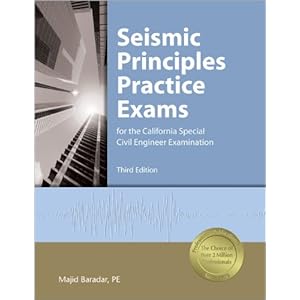
Seismic Principles Practice Exams for the California Special Civil Engineer Examination by Majid Baradar

Seismic Principles Practice Exams for the California Special Civil Engineer Examination by Majid Baradar

Seismic Principles Practice Exams for the California Special Civil Engineer Examination by Majid Baradar Overview

The Most Realistic Seismic Exam Practice You Can GetThe best way to assess your readiness for the California Special Civil Engineer Seismic Examination is to take a practice exam as similar to the actual exam as possible. Seismic Principles Practice Exams provides the most realistic practice you can get.

These two complete practice exams, each with 47 multiple-choice problems, are designed to mimic the range of topics and degree of difficulty of the actual exam. With each exam, you can practice your problem-solving skills, find out how long you take to solve different types of problems, and determine which subject areas require more review or practice. Fully explained, step-by-step solutions are provided for each problem, allowing you to check your answers and understand the most efficient solving methods.

To develop your familiarity with the seismic codes used in the exam, Seismic Principles Practice Exams references the 2006 International Building Code (which contains the same material and section codes as Volume II of the 2007 California Building Code) and the 2005 Minimum Design Loads for Buildings and Other Structures.

Seismic Principles Practice Exams will help you pass the actual exam by
• Mentally preparing you for the pressure of working under timed conditions
• Assessing your problem-solving skills
• Reviewing seismic building codes
• Identifying topics that require extra review